
- Acupuncture
- Chiropractic
- Examination & Treatment
- Head Shaking and Electroacupuncture
- Appointments
- Fees
- F.A.Q.
- Case Histories
- Testimonials
- Veterinary Care Book
- Personal Background
- CPD for Vets
Meadow Rise
The Street
Farley
Salisbury
Wiltshire
SP5 1AB
Tel./Fax: 01722 712 802
Mobile: 07866 431 888
sue@equineacupuncture.co.uk


What is acupuncture?
Acupuncture is a treatment that involves inserting fine, sterile, stainless steel needles into specific points of the body to prevent and treat disease. The treatment evolved over 3000 years ago in China and it is now being used in veterinary and medical practices throughout the world. In veterinary medicine, acupuncture is increasingly being recognised as a useful treatment for a wide range of conditions.
What conditions can acupuncture be used for?
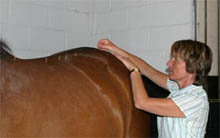
Horse undergoing acupunture treatment
Acupuncture can be used as part of a treatment protocol for almost any medical condition with the exception of malignant tumours, irreparable fractures and end stage organ failure. It is often used in combination with conventional veterinary treatment so the patient experiences the benefits of the combined effects.
In equine practice, acupuncture is commonly used for the relief of musculoskeletal pain and to influence the function of internal organs. It is especially useful for treating:
- Any type of muscle soreness, particularly of the neck, shoulders, back and hindquarters. Clinical signs that may be alleviated by acupuncture include:
- Cold backs - resentment of saddling and girthing, dipping on mounting
- General stiffness, inability to bend on one or both reins
- Head tilt, inability to flex from the poll
- Shortness of stride, not going forward from the leg
- Disunited or bunny-hopping at canter
- Moving unlevel behind
- 'Hopping' on the transition from walk to trot
- Bucking on the transition from trot to canter
- Irritability and soreness during grooming
- Arthritis
- Sacroiliac pain
- Digestive problems including poor appetite, diarrhoea and some types of colic
- Respiratory problems
- Reproductive problems
- Poor immunity and post viral lethargy
Who can do acupuncture?
By law, acupuncture can only be performed by a qualified veterinary surgeon who has undergone special training in the technique. This is because it is an invasive procedure that requires a thorough knowledge of veterinary anatomy and physiology.
How does acupuncture work?
Western Scientific Explanation
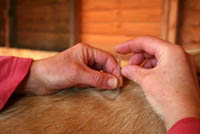
Inserting an acupunture needle
Inserting acupuncture needles stimulates tiny nerve endings that carry impulses to the spinal cord and brain. This results in responses within the nervous and endocrine systems, leading to the release of neurotransmitters and hormones. These influence the function of the body tissues and organ systems.
The effect of an individual needle is determined by where it is placed in the body and which nerves are stimulated - hence the need for a thorough knowledge of veterinary anatomy and physiology.
Acupuncture increases the release of natural painkillers such as endorphins, enkephalins and serotonin which act on the pain pathways in the brain and spinal cord and can block the transmission of incoming pain signals.
Traditional Chinese Medicine (TCM)
Health can be defined as a state of harmony of an animal with its internal environment and within its external environment. There is complete physical, mental and social well-being and not merely the absence of disease.
An acupuncturist who practises TCM will look at the whole horse and not just the diseased part. Consideration will be given to why the disease developed in the first place. This is why it is important for the first examination to take place with the horse in its home surroundings rather than at a veterinary clinic.
The purpose of an acupuncture treatment is to restore the patient to a state of balance or homeostasis. By influencing part of the brain called the hypothalamus, acupuncture can affect homeostatic regulatory mechanisms such as the control of blood pressure, pulse, respiration, intestinal motility, hormone secretion and white blood cell production.
Acupuncture as a preventative treatment
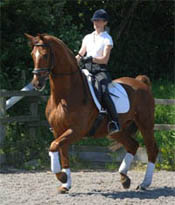
Acupuncture has a valuable role as a preventative treatment. Fit competition horses taking part in a wide range of disciplines are prone to developing minor injuries that often go unnoticed. Eventually these build up and cause the horse to compensate by altering its way of moving and this makes it susceptible to more serious injury.
Regular examination and treatment throughout the season can catch these injuries at an early stage. By restoring normal blood supply and function to the muscles, they heal quickly and competition schedules are uninterrupted.